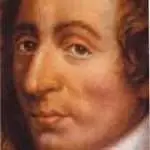
Blaise Pascal

BLAISE PASCAL

1623-1662 CE

The heart has reasons that reason cannot know. Bet on God's existence — you lose nothing if wrong, gain everything if right.

Difficulty:
Born: 1623 in Clermont-Ferrand, Auvergne, France
Died: 1662 (aged 39)
Nationality: French

Personal Character

Child prodigy who became mathematician, physicist, inventor, and religious philosopher — all before dying at thirty-nine. Sickly from youth, suffering chronic pain and illness that shaped his existential outlook. At twelve, independently discovered Euclidean geometry's first thirty-two propositions despite his father hiding mathematics books. At sixteen, published a theorem on conic sections that astounded mathematicians. At nineteen, invented the mechanical calculator to help his father's tax work — the first digital calculator. Brilliant, intense, melancholic. In 1654, at age thirty-one, he experienced a mystical "night of fire" that transformed him from scientist to religious thinker. Sewed the written account into his coat lining and carried it until death. Joined Port-Royal, Jansenist community emphasizing Augustine's theology of grace, and defended them against Jesuits in devastating satires. Spent final years writing notes for a Christian apologetic — never completed, published posthumously as Pensées (Thoughts). Tortured by illness, died at thirty-nine. Left behind fragments that became one of literature and philosophy's treasures. Combined mathematical rigor with religious passion, scientific precision with mystical fervor.

Death Circumstances

Died in Paris in 1662, aged thirty-nine, from what was probably stomach cancer that had metastasized to his brain. He suffered excruciating pain in his final months. His last words were reported as "May God never abandon me."

Last Words

"May God never abandon me" (Que Dieu ne m'abandonne jamais), spoken to the priest attending him.

Born in 1623 in Clermont-Ferrand, son of Étienne Pascal, a tax official and amateur mathematician. His mother died when he was three. His father, recognizing Blaise’s genius, educated him personally, initially withholding mathematics to develop other subjects first. But at twelve, Blaise independently discovered geometry’s first propositions. His father relented and introduced him to mathematics formally.

At sixteen, Pascal published Essay on Conic Sections, proving theorems that astounded professional mathematicians. At nineteen he invented the Pascaline, a mechanical calculator using gears and wheels — the first digital calculating machine, built to help his father’s tax work. He produced about fifty calculators, though they were too expensive for wide use.

In his twenties he made fundamental contributions to probability theory, corresponding with Fermat about gambling problems. Their work founded probability mathematics. He conducted experiments on atmospheric pressure, proving that air has weight and that vacuums can exist — challenging Aristotelian physics. He invented the syringe, hydraulic press, and barometer. His scientific output was extraordinary.

But on November 23, 1654, everything changed. He experienced a profound mystical vision lasting about two hours — his “night of fire.” He wrote a record on parchment: “FIRE. God of Abraham, God of Isaac, God of Jacob, not of the philosophers and scholars. Certitude. Certitude. Feeling. Joy. Peace. God of Jesus Christ… Joy, joy, joy, tears of joy.” He sewed this memorial into his coat lining and carried it the rest of his life.

He withdrew from scientific society and joined Port-Royal, a Jansenist community. Jansenism emphasized Augustine’s theology of grace, predestination, and human depravity, putting them in conflict with Jesuits who emphasized free will and reason. When the Jesuits attacked Port-Royal, Pascal defended it in Provincial Letters (1656-1657), devastating satires of Jesuit casuistry that became French literature classics.

He spent his final years planning a Christian apologetic for skeptics and freethinkers. He made notes on scraps of paper, organizing them into bundles. The work was never completed. He died in 1662 at thirty-nine from illness. The notes were published posthumously as Pensées (Thoughts), fragmentary but brilliant, containing the Wager argument and reflections on human condition that remain startlingly modern.

After his mystical experience in 1654, Pascal wrote the Memorial describing it and sewed the parchment into his coat lining. When he changed coats, he carefully transferred it to the new one. He told no one about it. Only after his death, when servants were preparing his clothes, did they discover the hidden document by feeling an unusual thickness in the lining. They cut it open and found the Memorial — Pascal had carried his secret conversion experience literally next to his heart for eight years. The discovery explained his sudden withdrawal from science and society. The man of reason had encountered something beyond reason and never stopped treasuring that moment.
Pascal's Wager says you should fake belief to hedge your bets. Actually, Pascal knew you can't force yourself to believe. The Wager shows that investigating Christianity is rational given the stakes. Begin the investigation, immerse yourself in practices, pray, take holy water — belief may follow. The Wager motivates inquiry, not pretense.
Epochs
Scientific Revolution
Schools
Christian Philosophy Rationalism
Philosophical Themes
DIVERSION FAITH GRACE HEART INFINITY PARADOX REASON WAGER
Pascal remained fervently Catholic and defended Christianity against skeptics and freethinkers, yet his apologetic strategy conceded so much to skepticism that it undermined traditional rational theology. He rejected the scholastic proofs of God's existence, arguing reason cannot reach God. He dismissed natural theology as useless for salvation. He emphasized faith as leap beyond reason, not conclusion of argument. His famous Wager treated belief as prudential calculation rather than response to truth. This pragmatic, fideistic approach shocked both Jesuits (who emphasized reason's capacity) and traditional Augustinians (who emphasized grace, not gambling). Yet Pascal claimed to defend orthodox Christianity. The tension was between his acceptance of reason's limits (influenced by Montaigne skepticism and his own scientific work showing nature's mysteries) and his passionate Christian commitment. He synthesized skepticism and faith by making reason show its own inadequacy, preparing the heart for grace. The container held because his target was rationalist hubris, not Christian doctrine. But his strategy of fideism — believing without or against reason — opened paths later thinkers followed away from Christianity. Kierkegaard and existentialists absorbed his leap of faith while dropping the Christian content. His heart/reason distinction anticipated Romanticism's revolt against Enlightenment rationalism. He remained orthodox but his methods were revolutionary.

Quotes

  • ""The heart has its reasons, which reason does not know.""

    — Pascal's distinction between two modes of knowing. Reason operates through logic and demonstration. The heart grasps truths immediately through intuition and feeling. Some truths — first principles, moral values, God's existence — are known by heart, not proved by reason. This isn't anti-rationalism but recognition of reason's limits.

  • ""Man is only a reed, the weakest in nature, but he is a thinking reed.""

    — Pascal's view of human condition. We're physically weak, crushed by the universe's vastness. But consciousness makes us superior to all that crushes us. A thinking being knows its death; the universe that kills us knows nothing. Our dignity lies in thought, not strength.

  • ""Let us weigh the gain and the loss in wagering that God exists. If you gain, you gain all; if you lose, you lose nothing. Wager, then, without hesitation that He exists.""

    — Pascal's Wager — his most famous argument. Belief in God is a bet. If God exists and you believe, you gain eternal happiness. If God doesn't exist and you believe, you lose nothing important. If God exists and you don't believe, you lose everything. Therefore, rationally, you should wager on God's existence.

MASTERWORK

Pensées (Thoughts)

Published posthumously in 1670 from his fragmentary notes for a Christian apologetic. Unfinished, unorganized, brilliant. Contains the Wager, reflections on human misery and greatness, critiques of philosophy, and passionate defense of Christianity.
WORK

Provincial Letters (Lettres provinciales)

Eighteen letters published 1656-1657 satirizing Jesuit moral casuistry and defending Jansenism. Masterpieces of French prose, devastating in their wit. Got Pascal in serious trouble with authorities.
WORK

Treatise on the Arithmetical Triangle

Published 1654, his mathematical work on what's now called Pascal's Triangle. Each number is the sum of the two above it. Fundamental to probability theory and combinatorics.
WORK

New Experiments Concerning the Vacuum

Published 1647, reporting his experiments with barometers and atmospheric pressure. Proved that air has weight and vacuums can exist, challenging Aristotelian physics that denied vacuum possibility.
WORK

On the Geometric Spirit (De l'Esprit géométrique)

Unfinished work on method and pedagogy. Distinguishes geometric (deductive) and intuitive minds. Shows how his mathematics informed his epistemology.
Pensées, selections on human condition and the Wager — Read a good anthology selecting key fragments. "Disproportion of Man," "The Wager," "Thinking Reed" passages are accessible, powerful, and require no background. They capture his genius and urgency.
The Pascaline (physical artifact, not text) — His mechanical calculator still exists in museums. Seeing the intricate gear system this teenager invented makes his genius tangible. Bridging mathematics and engineering, theory and practice, it embodies his unified brilliance.
RESPONDS TO
  • Montaigne (skepticism and self-examination), Descartes (rationalism and proofs of God), Aristotle (vacuum and physics), Epictetus and Stoics (human dignity), Augustine (grace and predestination), Jesuits (casuistry and theology)
INFLUENCES
  • Kierkegaard (leap of faith), Dostoyevsky (religious existentialism), William James (will to believe), Nietzsche (acknowledged Pascal as opponent), Heidegger (anxiety and authenticity), existentialism (absurdity and choice), decision theory (expected utility), probability theory (foundational work)
ARGUED AGAINST
  • Cartesian rationalism (reason alone can't reach God), Jesuit casuistry (moral laxity), Stoic self-sufficiency (pride), natural theology (proves useless God), libertine skepticism (ignores stakes), Aristotelian physics (vacuum denial)

Visual Simile

Imagine you're lost in a vast desert at night under stars so numerous they make you dizzy. You're infinitely small beneath infinite space. But you're also infinitely large compared to the atoms composing your body, infinitely complex universes in themselves. You exist between these infinites, understanding both but belonging to neither. You can count the stars but can't reach them. You can think about atoms but can't see them. You're aware of your insignificance (crushed by vastness) and your significance (only you know you're crushed). A rock doesn't know it's small. You do, which makes you greater than the cosmos crushing you. Now you're thirsty, lost, scared. You see two paths. One leads (maybe) to an oasis with infinite water. The other leads (maybe) to nothing. You can't see which path leads where — it's too dark. But you must choose. If you take the oasis path and you're right, you're saved. If you're wrong, you die thirsty. If you take the other path and there's no oasis, you die thirsty. If there was an oasis and you missed it, you die thirsty. Given these stakes, which path do you take? Pascal says: take the oasis path. Even if you're only 10% sure it exists, the payoff (infinite water) outweighs the cost (dying while seeking). The desert is life, the oasis is God, the darkness is uncertainty. We must wager because we can't remain suspended between infinites forever.

Pascal’s thought pivots on one insight: humans exist between two infinites — infinite greatness above, infinite smallness below — suspended in terrifying middle position. We’re too great to be mere animals, too small to comprehend the universe. This disproportion defines human condition. We can think about infinity but can’t grasp it. We seek happiness but find only misery. We desire certainty but live in doubt. We are wretched and glorious simultaneously.

This existential situation shapes his epistemology. He distinguished two ways of knowing: geometric and intuitive. Geometric knowledge proceeds from definitions and axioms through logical demonstration — mathematics exemplifies this. Intuitive knowledge grasps truths immediately without proof — we know we exist, we perceive first principles, we recognize moral truths. Neither reduces to the other. Some people have geometric minds, excelling at step-by-step reasoning. Others have intuitive minds, seeing wholes immediately. The complete thinker needs both.

But reason has limits. It cannot prove its own first principles — these are known intuitively. It cannot demonstrate God’s existence satisfactorily — the proofs are too abstract, proving a philosopher’s God not the God of Abraham. It cannot compel faith — belief requires the heart’s assent, which reason cannot force. Pascal rejected Cartesian rationalism’s confidence that reason could reach God through proof. The hidden God reveals Himself to hearts, not minds.

Yet he wasn’t irrationalist. Reason has proper sphere — mathematics, physics, empirical investigation. His own scientific work respected reason’s power within its domain. But religion transcends reason’s competence. Here the heart must lead. “The heart has its reasons, which reason does not know” isn’t dismissing reason but recognizing another mode of knowing appropriate to its object.

This led to his most famous argument: the Wager. Since reason can’t prove God exists or doesn’t exist, we must choose how to live without certainty. Frame it as bet. If God exists and you believe, you gain infinite happiness. If God doesn’t exist and you believe, you lose finite pleasures during life. The expected utility of belief is infinity times any probability, which outweighs any finite loss. Therefore, even if God’s existence is only slightly probable, rationality requires wagering on belief. Critics object that you can’t choose belief. Pascal knew this. The Wager shows that investigating Christianity is rational given the stakes. Immerse yourself in Christian practice, pray, take sacraments — belief may follow. The Wager motivates seeking, not faking.

His view of human nature was Augustinian. We’re fallen, corrupted by sin, capable of both greatness and depravity. Our misery proves we once had something better — unfallen nature whose loss we feel. Our grandeur proves we’re made for something higher — God. Without Christianity explaining the Fall and Redemption, human condition is inexplicable contradiction. We’re too wretched for philosophy’s consolations, too glorious for skepticism’s dismissal.

His apologetic strategy was unique. Rather than proving Christianity true, he showed that it uniquely explains the paradox we experience — misery and greatness, longing and disappointment, reason and mystery. It makes sense of us to ourselves. And given the stakes (eternal happiness or misery), ignoring Christianity is insane. Even if you doubt, you must investigate given what’s at risk.

Pascal died before organizing these thoughts into systematic apologetic. We have fragments, brilliant and urgent, pointing toward synthesis never completed. But the fragments changed philosophy by making human experience central, by treating religion existentially rather than theoretically, by combining rigorous thought with passionate commitment.

Pascal's Wager became philosophy of religion's most discussed argument, spawning endless responses and variations. Decision theory and expected utility theory in economics descended from his probability work. Existentialism absorbed his emphasis on human condition's absurdity, anxiety, and need for authentic choice. Kierkegaard leap of faith directly echoes Pascal. Dostoyevsky's Grand Inquisitor explores Pascalian themes. His critique of rationalism anticipated Romantic reaction against Enlightenment. His Provincial Letters influenced French prose style. His calculator inspired later computational machines. His distinction between knowing through heart and through reason influenced phenomenology and personalist philosophy. His apologetic strategy — showing Christianity makes sense of human paradoxes rather than proving it true — shaped modern theological method. William James "Will to Believe" is Pascalian pragmatism. Contemporary philosophy of religion constantly engages his Wager and his fideism.
Pascal speaks to contemporary crises of meaning and certainty. In secular age where traditional proofs of God fail to convince, his Wager offers pragmatic approach — even if you're not sure, the stakes warrant investigation. His recognition that the heart has reasons reason doesn't know challenges both religious rationalism and scientific materialism. Some truths resist quantification and proof. His view of humans caught between infinites resonates in age discovering cosmic vastness (billions of galaxies) and quantum smallness (subatomic particles). We're literally between infinites now, not metaphorically. His emphasis on diversion and distraction anticipates modern entertainment culture. We avoid existential questions through endless amusement — exactly what he diagnosed. His insistence that human condition is paradox (wretched and glorious) challenges both optimistic progressivism and pessimistic nihilism. We're neither as good as Enlightenment hoped nor as meaningless as postmodernism claims. His critique of purely rational religion applies to "God of the philosophers" versus lived faith distinction. Abstract theology disconnects from personal relationship with God. His mathematical genius combined with religious passion challenges false dichotomy between science and faith. One person can excel at both, kept in proper spheres.
Pascal's "thinking reed" parallels Buddhist recognition that consciousness is both suffering (dukkha) and the means to liberation from suffering. Awareness of existence brings pain but also possibility of transcendence. His infinite smallness and infinite greatness parallel Daoist recognition of humans caught between Heaven and Earth, participating in both. His heart/reason distinction parallels Zen's emphasis on direct insight (satori) beyond conceptual thought, though Pascal kept both rather than transcending reason. His wager argument parallels Pure Land Buddhism's call to recite nembutsu based on Amida Buddha vow — you can't prove it works, but stakes are too high not to try. His view of human wretchedness and grandeur parallels Hindu recognition of maya (illusion) and atman (divine self) — we're trapped in false world yet essentially divine. His critique of diversion parallels Buddhist teaching that we flee dukkha through attachment to pleasures that ultimately fail. Yet crucial difference: Pascal's misery comes from Fall and is redeemed by Grace, not from ignorance redeemed by enlightenment. His solution is personal God's intervention, not realization of non-dual truth or emptiness.
The heart has reasons reason cannot know. Invented the calculator at nineteen, experienced mystical fire at thirty-one, died writing fragments at thirty-nine.
Accessibility
4/5
Originality
5/5
Influence
5/5
Impact
5/5
Relevance
5/5
4.8/5
Notes
Auto-saving... 0 characters

All Your Notes

Philosophy Chain
↺ Recently Visited
No recent visits
Classical 1
Classical Foundations (200 BCE-400 CE) 3
Classical Indian Philosophy 2
East Asian Buddhist Thought 1
Marxism & Social Critique 1
Medieval Hindu Renaissance 2
Neo-Confucian Revival 1
Postmodernism & Postcolonial Thought 2
Utilitarianism & Social Reform 2
Vedic & Upanishadic Thought 1